
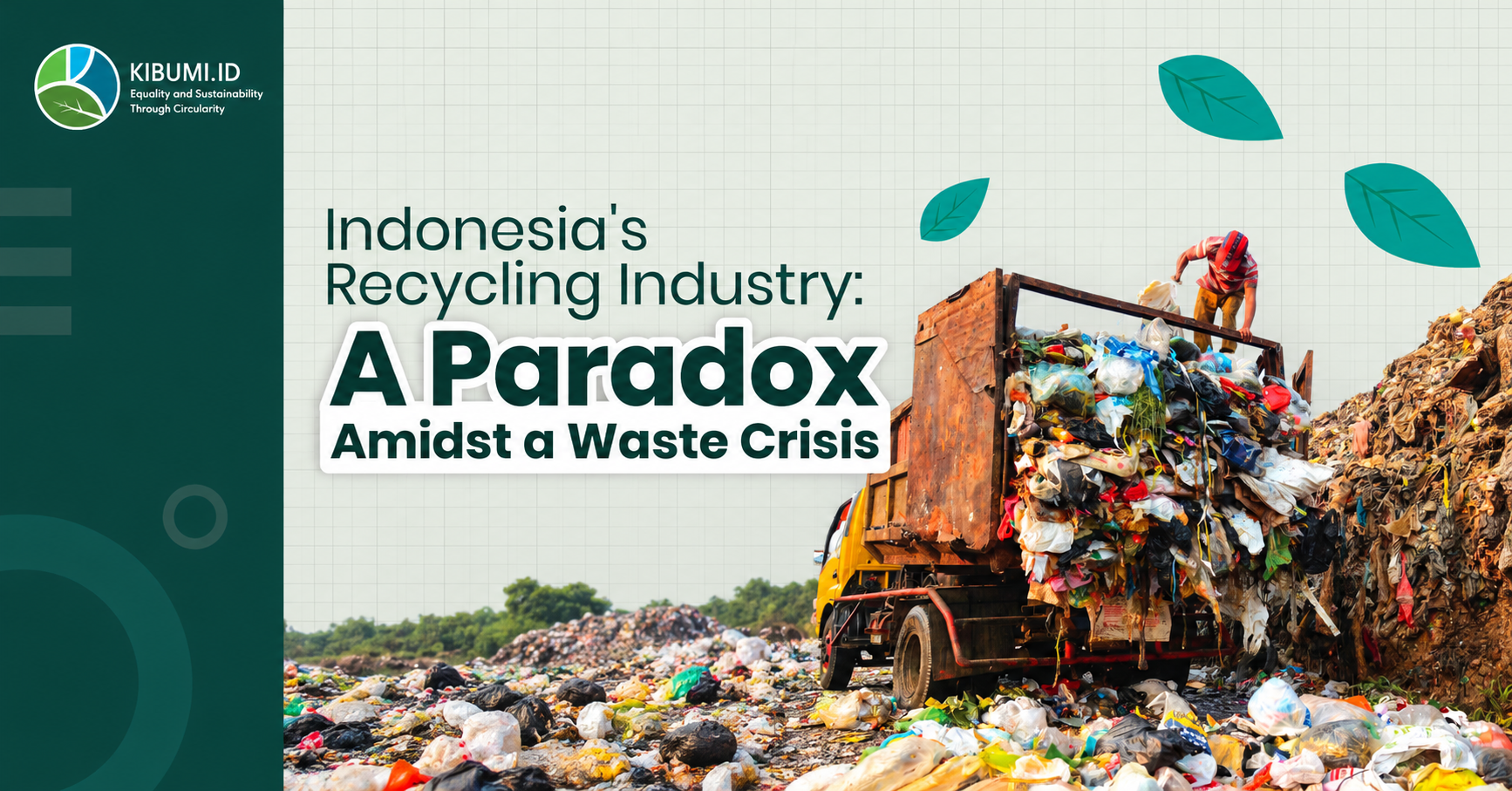
Indonesia's Recycling Industry: A Paradox Amidst a Waste Crisis
by Clara Citra Arundati
For years, plastic has been portrayed as the villain. But perhaps we've been asking the wrong question. The real challenge isn't plastic itself. It's whether we have a system capable of keeping it in circulation.
Every year, Indonesia generates tens of millions of tonnes of waste (Agamuthu & Babel, 2023). Yet Indonesia's plastic recycling industry has an installed processing capacity of approximately 3.16 million tonnes per year, while operating at only around 50% of that capacity because recyclers struggle to secure enough quality recyclable materials (ADUPI, 2026). Some even rely on imported feedstock to keep their production lines running.
That's the paradox. We're not running out of plastic. We're running short of a system that keeps plastic in the economy instead of letting it leak into the environment.
Today, Indonesia's recycling industry consists of approximately 227 large-scale and 522 small- and medium-scale recycling companies (ADUPI, 2026). The sector contributes billions of dollars to the economy, creates thousands of formal jobs, supports around one million informal workers (Rahman, 2025), diverts millions of tonnes of plastic waste, and reduces greenhouse gas emissions. The recycling industry is creating economic value and advancing the circular economy.
From our analysis, the challenges boil down to three interconnected issues:
1. Supply: An unstable supply of quality recyclables, driven by weak waste segregation, low-recyclability packaging, and reliance on the informal collection sector.
2. Processing Capacity: Poor-quality feedstock requires additional processing, while limited investment, technology, and standards constrain competitiveness.
3. Demand: Limited standards, insufficient policy incentives, and the absence of mandatory recycled-content requirements continue to constrain market growth.
We need to strengthen all 3 pillars of the recycling ecosystem:
Supply
• Strengthen waste management and EPR implementation.
• Improve waste segregation at source.
• Empower informal collection actors.
• Promote environmentally sound cross-boundary trade.
Processing Capacity
• Invest in recycling technologies and infrastructure.
• Strengthen standards and quality assurance.
• Introduce fiscal incentives.
• Encourage innovation and long-term investment.
Demand
• Introduce mandatory recycled-content requirements.
• Expand green public procurement.
• Encourage corporate procurement commitments.
• Strengthen market confidence in recycled materials.
Building a circular economy is not about choosing between the environment and economic growth. The two go hand in hand.
Plastic was never destined to become waste. It only becomes waste when the system fails.
What should Indonesia prioritize to unlock the full potential of its recycling industry?
For more information please check this link :
https://www.linkedin.com/feed/update/urn:li:activity:7485557791542235137/
#CircularEconomy #WasteManagement #PlasticRecycling